The Remarkable Design of the Feline Tongue
Cats move with a unique blend of grace, precision, and quiet efficiency. Whether stalking prey or curled peacefully on a windowsill, their movements reflect an evolutionary mastery refined over millions of years. One of the most extraordinary features behind this elegance lies hidden inside their mouths: the feline tongue.
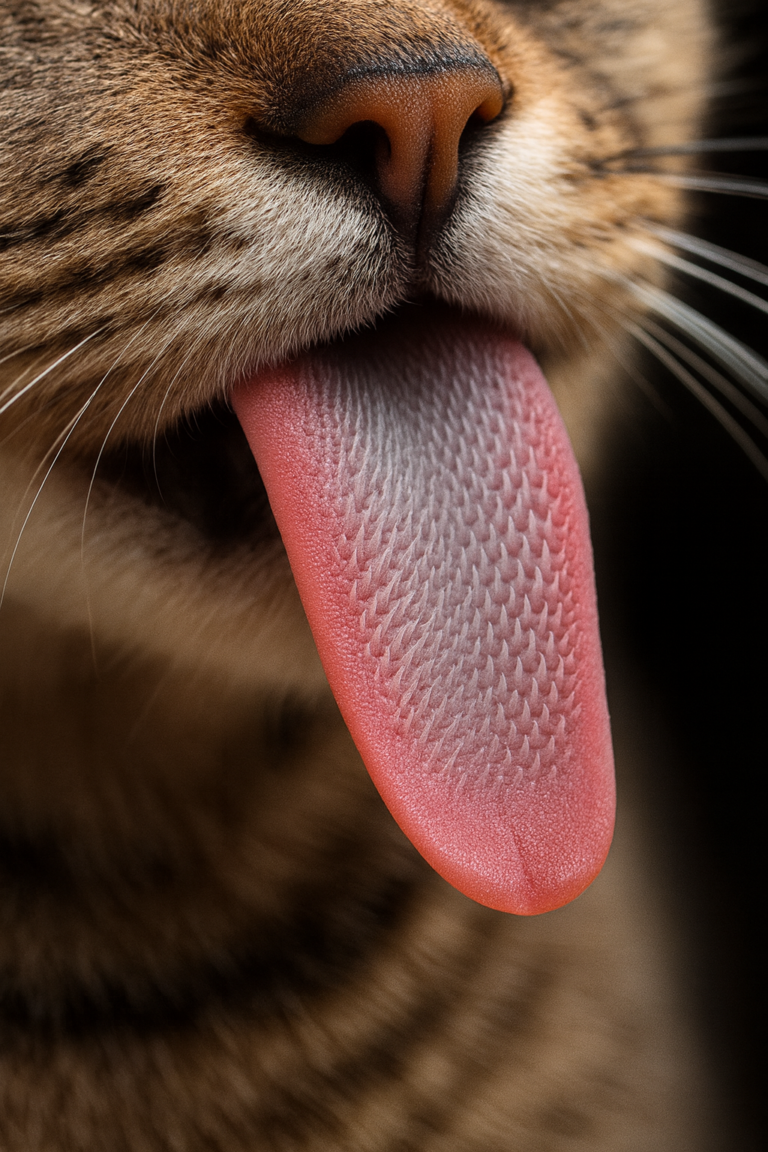
At first glance, a cat’s tongue appears soft and smooth. Under magnification, however, it becomes a fascinating landscape of specialized structures. The surface is covered with hundreds of backward-facing keratin spines known as papillae — tiny, hook-like projections made from the same material as human fingernails. These structures act like miniature combs, penetrating deep into the fur to remove loose hair, debris, and parasites with remarkable efficiency.
This ingenious system goes far beyond grooming. The papillae help cats grip and tear meat, efficiently scrape nutrients from bones, and even aid in hydration by allowing them to scoop water in a precise, ladle-like motion. In warmer conditions, the tongue plays a vital role in thermoregulation as cats spread saliva across their coat, helping cool the body as it evaporates.
Engineers and scientists continue to study the feline tongue, using it as inspiration for innovative grooming tools, medical brushes, and fluid-transfer devices. Its form and function demonstrate how natural selection shapes biological systems that are both powerful and efficient.
From the lion roaming the savannah to the domestic cat grooming on a sofa, this remarkable tongue reveals yet another example of nature’s ability to engineer highly specialized solutions for survival, comfort, and adaptability. Each careful stroke during grooming is a quiet demonstration of biological brilliance in action.
Views: 19
https://shorturl.fm/c21Uh
https://shorturl.fm/YPsuA
https://shorturl.fm/QvsAD
Start earning on every sale—become our affiliate partner today!
Monetize your traffic instantly—enroll in our affiliate network!
Become our partner and turn referrals into revenue—join now!
Turn your network into income—apply to our affiliate program!
Drive sales, collect commissions—join our affiliate team!
Share our link, earn real money—signup for our affiliate program!
Join our affiliate program and watch your earnings skyrocket—sign up now!
Get rewarded for every recommendation—join our affiliate network!
Be rewarded for every click—join our affiliate program today!
Join our affiliate community and maximize your profits!
Hello https://is.gd/tvHMGJ
https://shorturl.fm/FwAtP
https://shorturl.fm/osbkF
https://shorturl.fm/mX9sw
https://shorturl.fm/j5xb0
https://shorturl.fm/HLXGj
https://shorturl.fm/rBIvW
Interesting take on bankroll management! Seeing tools like AI Video Generator streamline content creation makes adapting strategies easier – visuals help immensely. Responsive design is key for on-the-go analysis, too!
https://shorturl.fm/a9BAP
https://shorturl.fm/UxJYC
https://shorturl.fm/pHd4A
https://shorturl.fm/AOAc6
https://shorturl.fm/bEVs2