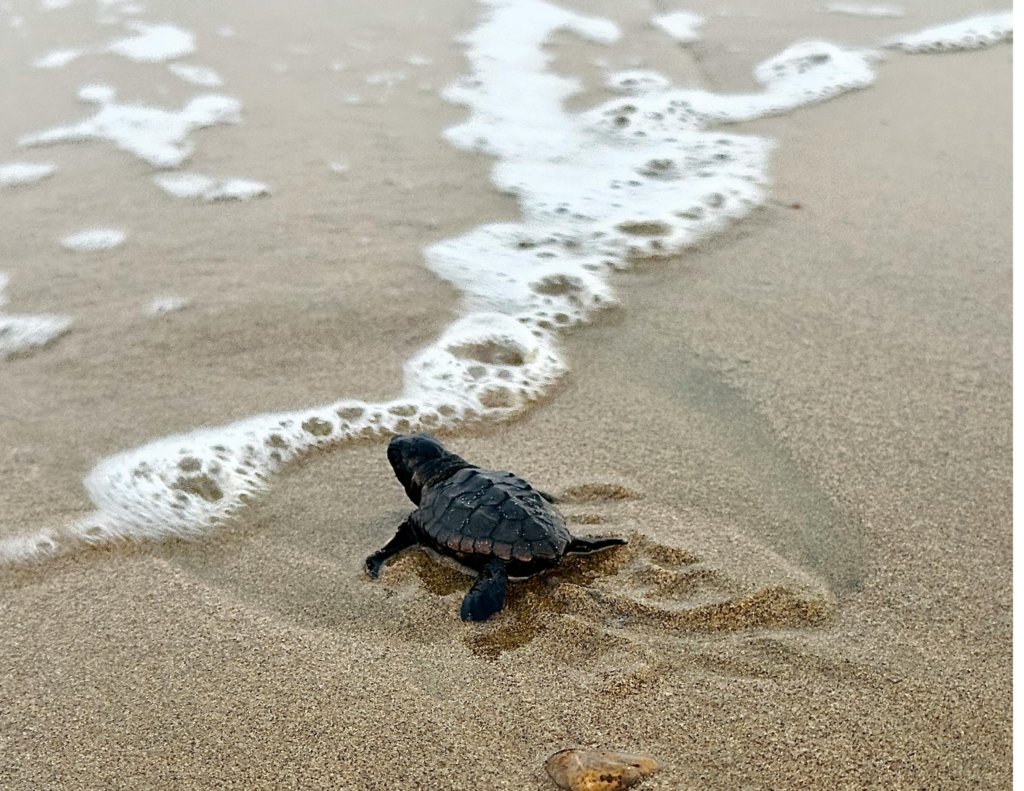
When a baby sea turtle hatches, it begins one of the most remarkable migrations in the animal kingdom. Under the cover of night, the tiny turtle digs its way out of the sand, heads toward the naturally brighter horizon above the ocean, and enters the water. From that moment on, it must survive entirely on its own—no parents to guide it, no older turtles to follow.
Yet these hatchlings travel thousands of miles across open ocean with astonishing accuracy. They cross entire gyres, follow long-distance currents, and eventually return to the general region where they were born.
Scientists are now uncovering how such young animals can navigate with such precision. Research shows that baby sea turtles possess a specialized magnetic sense, likely influenced by microscopic magnetite particles within their tissues. These particles help them detect and interpret Earth’s magnetic field, essentially giving them a built-in geographic map. As soon as they enter the water, this sensory system activates, helping them determine their position and the direction they need to swim—even in the absence of visible landmarks, light cues, or familiar coastlines.
This magnetic navigation ability is a highly refined biological adaptation—one that allows hatchlings to begin extremely long migrations from the moment they reach the ocean. It highlights the complex sensory systems that many animals have evolved in order to survive in challenging environments.
Every tiny turtle that slips into the waves carries within it the tools needed for a journey that spans oceans, guided by instincts and sensory mechanisms scientists are still working to fully understand.
Views: 18
https://shorturl.fm/1LODK
https://shorturl.fm/OxZPm
https://shorturl.fm/vRI6X
https://shorturl.fm/vnSHf
Share our products and watch your earnings grow—join our affiliate program!
Sign up for our affiliate program and watch your earnings grow!
Refer friends and colleagues—get paid for every signup!
Promote our brand and watch your income grow—join today!
Start earning instantly—become our affiliate and earn on every sale!
Get rewarded for every recommendation—join our affiliate network!
Promote our products—get paid for every sale you generate!
Partner with us and enjoy recurring commission payouts!
Share your unique link and earn up to 40% commission!
Enter your invite code to earn your airdrop on Aster https://is.gd/ZceEI6
https://shorturl.fm/EQqvO
https://shorturl.fm/P8Myg
https://shorturl.fm/7Iojq
https://shorturl.fm/pbifT
https://shorturl.fm/MkcKn